The year 1971 marked a pivotal moment in Hersheypark’s history, signaling a fundamental shift in its operations and future direction. The introduction of a gated entrance was driven by two major factors. Primarily, it served as a necessary response to heightened security concerns following incidents of vandalism during the 1960s, including damage to the Lost River ride’s elephant and minor harm to Laffin’ Sal. Secondarily, this change was a clear preparatory step toward a significant modernization and transition into a full-fledged theme park.
While Phase I of the R. Duell & Associates (RDA) master plan—highlighted by the construction of Carrousel Circle—didn’t officially commence until late 1971, the park’s actions effectively established 1971 as a “Phase 0” year for the extensive changes that were about to transform the park.
Planning
The planning for Hersheypark’s 1971 season began in October 1970, overseen by General Manager John Hart and Dr. John O. Hershey, a vice president of Hershey Estates tasked with the park’s renovation. Dr. Hershey (who was not related to Milton S. Hershey) was responsible for securing the approval of the Hershey Entertainment & Resorts Company (then operating as Hershey Estates) Board of Directors for the operational plan developed by Hart and his team.
Hart’s October 1970 proposal for the 1971 Park Season outlined several recommendations. While elements concerning the schedule, promotion, income, and wages required executive sign-off, the section on capital expenditures was presented as crucial for the park’s 1971 operations and was therefore strongly encouraged for approval.
For the 1971 season, the pay-per-ride ticketing structure was to remain, though “incentive days” offering unlimited ride access for a single price were expanded. Ride prices increased, with a 5-cent hike for kiddie rides, the Miniature Railroad, and the Magic Carpet Giant Slide, and a 10-cent increase for all other rides.
On February 25, 1971, Hart sent a memorandum to Dr. Hershey suggesting modifications to the initial plan. These alternative options were proposed due to two recent key developments: a strong desire to include an animal act in the 1971 season’s entertainment and a lack of available free talent for guest entertainment. Hart advocated for several changes, ultimately backing the implementation of a small general admission fee, a single-price ticket for all rides, and an hourly animal performance at the Bandshell.
The Park, gated
While the capital expenditures section in Hart’s October 1970 report focused on several proposals, the most important proposal was the fence to enclose Hersheypark.
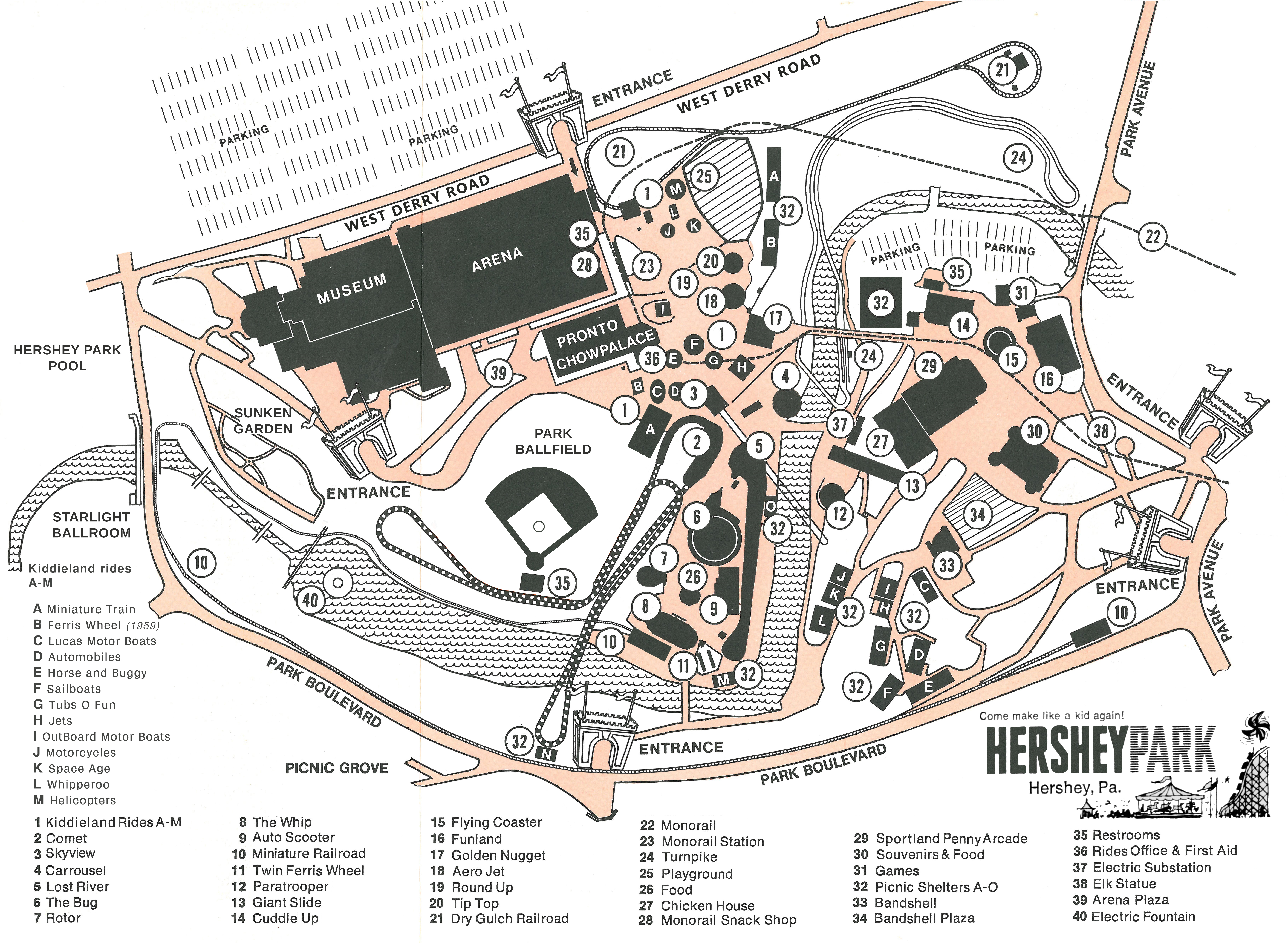
Hart explained that new fencing should be added around the park with the exception of approximately 1000 feet behind the houses on West Derry Road. That area already had a fence because of its proximity to one of Hersheypark’s rides – Dry Gulch Railroad. The cost of installing the fence would be approximately $50,000 per the park’s purchasing department while turnstiles would cost $20,000. That estimate was given to the park by RDA.
In the winter of 1971, the fence was constructed. The new perimeter began at the original main entrance on Park Boulevard, extending along Park Avenue until it reached the existing fence behind West Derry Road.
The fence then continued from Dry Gulch Railroad, at the corner of Lobby 1 of the Hersheypark Arena, running down the edge of the park to the Arena’s southeastern corner. From there, the fence followed the southern side of the Arena all the way to the Sunken Garden, near the Hershey Park Pool.
Finally, the fence turned down Park Boulevard, completing the enclosure by returning to its starting point at the original main entrance.
The five entrances
On March 8, 1971, Hart met with park operations manager Stanely Carpenter. Hart explained that regarding the new fence, ticket booths should be installed at certain locations along the new perimeter. Management was concerned that the new entry procedure would initially confuse local visitors. Placing ticket booths at the most frequently used entry points prior to the fence would help them.
Ticket booths were placed at the original main entrance of Hersheypark, opposite the entrance of Hershey Park Zoo, opposite the picnic grove, one booth for two cashiers at the entrance by the Arena, two booths handling four cashiers at the gate leading into the athletic field. Except on special occasions, the two booths at the athletic field and the one at the picnic grove would be operated on Saturdays and Sundays.
One ticket booth was renovated and placed adjacent to the Arena entrance to be an information booth.
A comprehensive advertisement explaining all the changes for the upcoming season was printed in the Pennsylvania Labor News, a publication widely seen by Hershey workers.
This advertisement was either made by the Labor News itself, or it was made by one of the union members in Hershey who would have submitted this kind of information to the Labor News – it would not have been made by Hersheypark management. This explains why we see the use of an old logo in 1971, as well as Hersheypark being spelled as two words since the park had renamed itself from Hershey Park to Hersheypark this season.
The park’s changes were officially announced to the public on April 14, 1971, only four days before its opening on April 18.
The cost of entering Hersheypark
In February 1971, management made the decision to charge a fee for entry into Hersheypark. There were two plans, One-Price Admission Plan, and General Admission Plan.
Adults (ages 12 and older)
$3.50 per personJunior (ages 5 - 11)
$1.75 per personAdults (ages 12 and older)
$1.00 per personJunior (ages 5 -11)
$0.50 per personThe park’s justification for introducing the One Price Admission Plan was that buying the one-price ticket was cheaper if you wanted to ride every ride. Purchasing tickets for each ride would have cost more. This is true – it would have cost $4.60 to ride every ride in Hersheypark.
However, park management anticipated guest resistance to the new one-price admission system. To address this, they introduced a General Admission Plan, primarily to ease local visitors into the new Hersheypark. Under this plan, guests paid an initial fee, and then purchased individual ride tickets for their desired attractions.
Reaction to the changes
The debut of Hersheypark’s new gated entry system in 1971 marked a major shift, primarily through the introduction of an entrance fee. This change, while accepted by many, met with resistance from many locals who were accustomed to the former, free-access setup of the old Hershey Park. However, not all local sentiment was negative; some residents acknowledged the necessity of the park’s modernization efforts.
In 1971, the public’s focus on Hersheypark’s new admission fee largely eclipsed other significant park changes. For instance, the implementation of five separate entrances garnered minimal attention. Media coverage was inconsistent; some sources, such as the York Daily Record, specified the five entrances, while others made only general references to multiple entry points or simply noted the park’s new enclosed, admission-charging status.
Similarly, the park’s new name, “Hersheypark,” went largely unnoticed in 1971. Its adoption only became more prominent with the introduction of the new pinwheel logo the following year, in 1972.
Images and video
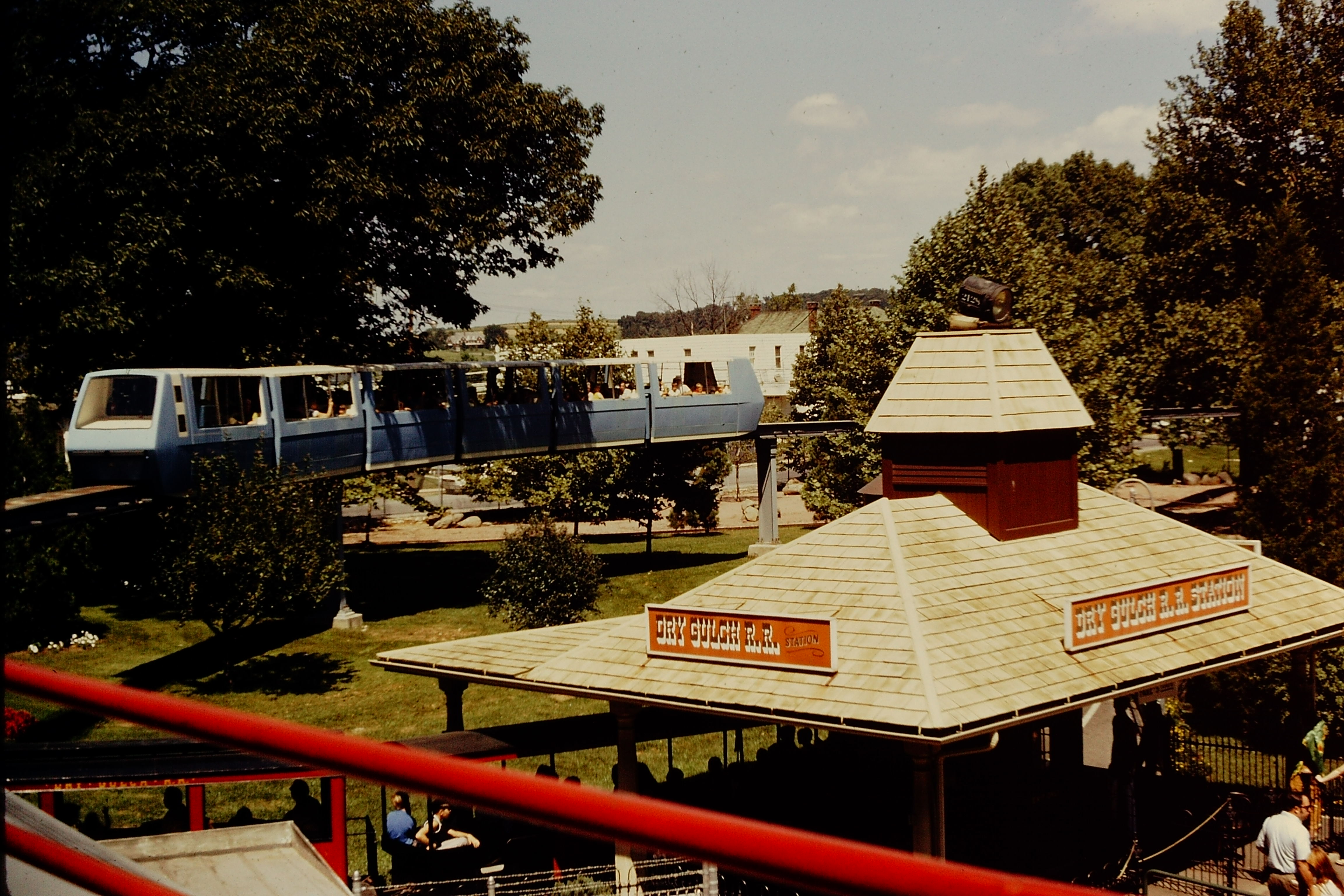
There are very few pictures of the park in the 1971 season, especially of any of the entrances to the park that year. One entrance can be seen in a picture of the Monorail (the roof of a ticket booth at the entrance is visible in the lower right corner of the image.
You can see part of the original main entrance area where two entrances were placed for the 1971 season. You can’t see the gates, but you can see the landscaping.
There are surprisingly few photographs or film showing any of the entrances in 1971 or 1972. If you have anything you would like to submit to be added to this post, mention that in the comments section below, and I’ll respond.
2 Responses